On Friday, as the school year wrapped up for our Homeschool group we belong to, the kids got to partake in a traditional Jewish Seder.
This ceremony is a deeply rooted and special observance of Passover. Passover refers to the time when the angel of death that God sent "passed over" the houses of the Jews when he was slaying the firstborn of Egypt.
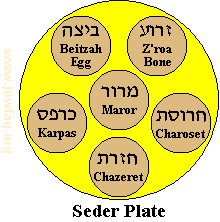
The plate, that you see above, is the plate that is used during the service and each spot is symbolic.
Probably the most significant observance related to Passover involves the removal of chametz (leaven) from our homes. This commemorates the fact that the Jews leaving Egypt were in a hurry, and did not have time to let their bread rise. It is also a symbolic way of removing the "puffiness" (arrogance, pride) from our souls.
What does the plate symbolize?
Karpas: Vegetable
A vegetable (usually parsley) is dipped in salt water and eaten. The vegetable symbolizes the lowly origins of the the Jewish people; the salt water symbolizes the tears shed as a result of our slavery. Parsley is a good vegetable to use for this purpose, because when you shake off the salt water, it looks like tears.
 (As you can see, Ashton wasn't too fond of the parsley...or any of the food for that matter! :) )
Maror & Chazeret: Bitter Herbs
A blessing is recited over a bitter vegetable (usually raw horseradish; sometimes romaine lettuce), and it is eaten. This symbolizes the bitterness of slavery. The maror is dipped in charoset, a mixture of apples, nuts, cinnamon and wine, which symbolizes the mortar used by the Jews in building during their slavery.
 (Ethan wasn't too crazy about the bitter herbs either!)
Beitzah Egg:
One of the reasons for the egg at the seder is because it symbolizes the beginning of life and Passover marks the very beginning of the Jewish national existence.
Z'roa bone:
is a lamb shank bone or roast chicken wing that symbolizes the korban Pesach (Passover sacrifice), which was a lamb that was offered in the Temple in Jerusalem, then roasted and eaten as part of the meal on Seder night. Since the destruction of the Temple, the z'roa serves as a visual reminder of the Pesach sacrifice.
Another important part to this ritual is the drinking of wine. The Kaddesh (Sanctification) is a blessing over wine in honor of the holiday. The wine is drunk, and a second cup is poured. After the Maggid, which is a retelling of the story found in Exodus, another blessing is recited, the second cup of wine is drunk and another one is poured.
A third cup of wine is poured, and birkat ha-mazon (grace after meals) is recited. At the end, a blessing is said over the third cup and it is drunk. The fourth cup is poured, including a cup set aside for the prophet Elijah, who is supposed to herald the Messiah, and is supposed to come on Passover to do this. The door is opened for a while at this point to wait for Elijah.
 Then in closing various hymns and prayers are given with a wish that they again return the next year to celebrate Passover.
Here is our history teacher, Cindy Pillings, performing the Seder Ceremony!


1 comment:
Wow! How cool is it that they got to participate in that?! My husband has sat through a few seders, but I've never had the opportunity.
Cute pics of the boys...
Post a Comment